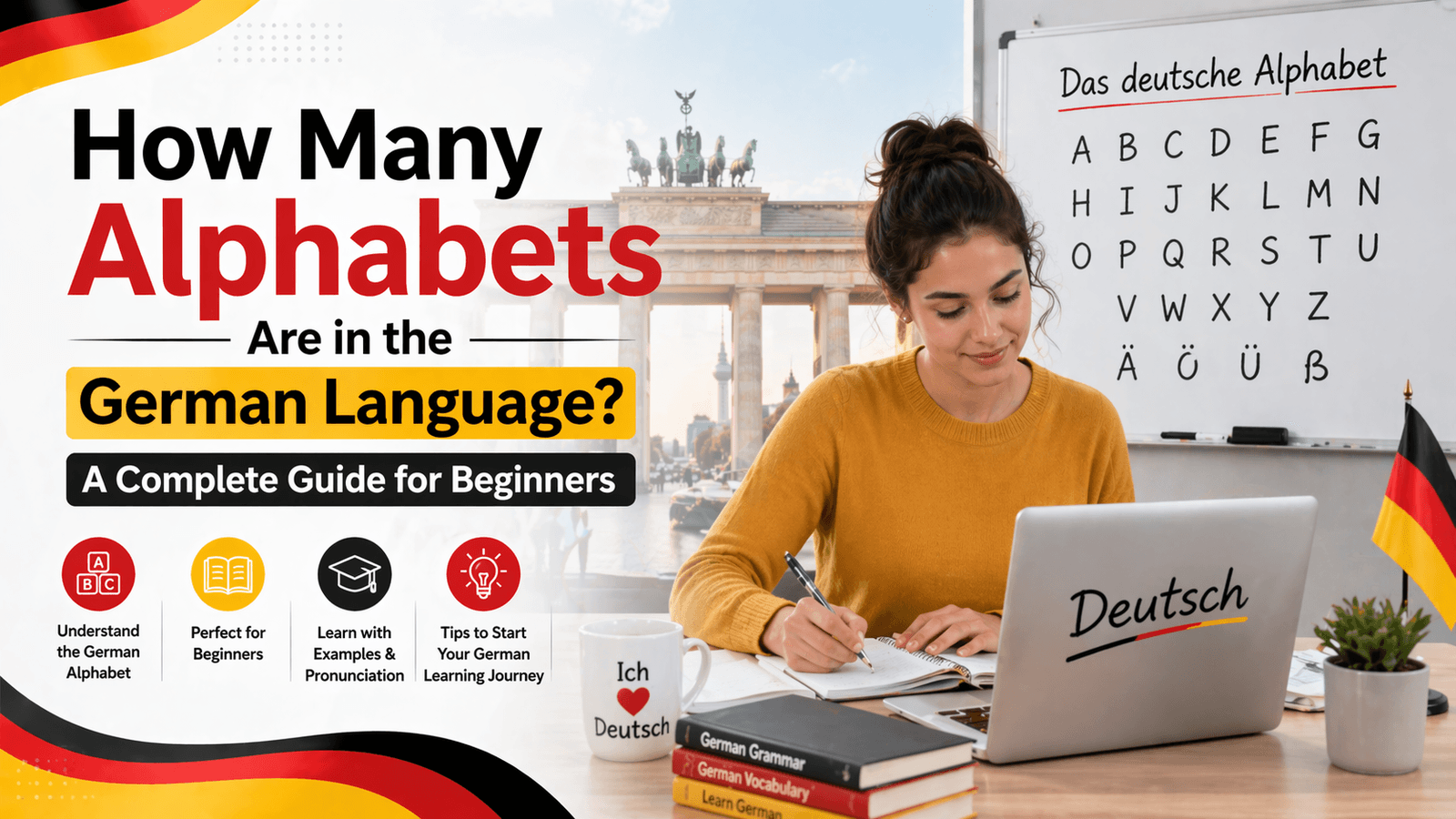
How Many Alphabets Are in the German Language? A Complete Guide for Beginners
Updated on April 22, 2026
If you have ever wondered, "How many alphabets are in the German language?" you are not alone. This is one of the most searched questions by students who are just starting their German language learning journey. The answer is both simple and fascinating: the German alphabet has 26 standard letters — the same as English — but it also includes 4 additional special characters that make it uniquely German. These special characters are the three umlauts (A with umlaut, O with umlaut, U with umlaut) and the Eszett (sharp S), bringing the total to 30 characters in the complete German alphabet.
In this detailed guide, we will explore everything you need to know about the German alphabet — its letters, special characters, pronunciation, and how learning German alphabets correctly can set a strong foundation for mastering the German language. Whether you are a complete beginner or someone brushing up on basics, this guide is your perfect starting point.
And if you are looking for the best German language course in Delhi to take your learning to the next level, Team Foreign Languages at Laxmi Nagar, New Delhi is here to guide you from A1 to C2. Visit germanlanguagecoursenearme.com to learn more.
Start Learning German Today! Call Us: +91 92180 71730
Mon-Sat: 9:00 AM - 7:00 PM | Visit: germanlanguagecoursenearme.com
Explore complete details about levels, fees, and benefits of learning German in our guide on German language course:
https://www.germanlanguagecoursenearme.com/blog/german-language-course
The German Alphabet — 26 Letters + 4 Special Characters
The German alphabet, known in German as "das Alphabet" or "das Abc," is based on the Latin script. It shares all 26 letters of the English alphabet — from A to Z — but it adds 4 unique characters that you will not find in the English alphabet. These are essential to understanding German pronunciation and spelling.
The 26 standard German letters are: A, B, C, D, E, F, G, H, I, J, K, L, M, N, O, P, Q, R, S, T, U, V, W, X, Y, Z.
The 4 special characters are: A-Umlaut (A with two dots above), O-Umlaut (O with two dots above), U-Umlaut (U with two dots above), and the Eszett (a sharp S character that looks like a capital B). Together, these 30 characters form the complete modern German alphabet.
Understanding these characters early in your German language learning is crucial. Mispronouncing an umlaut or ignoring the Eszett can completely change the meaning of a German word. For example, the German word "uber" (meaning over/about) sounds very different from "uber" with a U-umlaut, which changes both pronunciation and meaning. This is why structured German language classes are so important for beginners.
To understand German sentence structure in detail, you can read our complete guide on German Language Grammar:
https://www.germanlanguagecoursenearme.com/blog/german-language-grammar
Understanding German Umlauts — What Are They and How Are They Pronounced?
The word "umlaut" comes from the German word meaning "sound mutation." Umlauts are modified vowels that represent unique sounds not found in the English language. They are one of the most distinctive features of the German language and one of the first things students learn in any beginner German alphabet course.
A-Umlaut (the A with two dots)
The A-umlaut is pronounced somewhere between the English "a" as in "bed" and the "e" sound. It appears in common German words like "Zahnarzt" (dentist), "zahlen" (to pay), and "Mädchen" (girl). Many beginners confuse this with a simple "a" sound, but your German trainer will quickly correct that in class.
O-Umlaut (the O with two dots)
The O-umlaut has a rounded lip sound, similar to trying to say "e" while shaping your lips to say "o." It appears in words like "Osterreich" (Austria), "schon" with the umlaut (beautiful/already), and "Mochte" (would like). This sound does not exist in Hindi or English, which is why Indian students especially benefit from phonetic German pronunciation training in a classroom setting.
U-Umlaut (the U with two dots)
The U-umlaut is a high, rounded vowel sound. Think of it as saying "ee" but with rounded lips. Common German words with U-umlaut include "uber" with the umlaut (over/above), "Tur" with the umlaut (door), and "Mutter" — wait, that one does not have an umlaut — but "Muttter" with umlaut means something quite different! Precision matters in German, and professional German language training makes all the difference.
The Eszett — German's Most Unique Character
The Eszett (also written as "ss" in some contexts) is perhaps the most visually distinct character in the German alphabet. It looks similar to a capital B but is a lowercase letter. It represents a sharp or long "s" sound and appears in words like "Strasse" with Eszett (street), "Heiss" with Eszett (hot), and "Gruss" with Eszett (greeting). An important fact: In 2017, the German-speaking countries officially introduced a capital Eszett for the first time in history, meaning this character now has both lowercase and uppercase forms.
Learn German Alphabets & Pronunciation from Expert Trainers!
Email: info@teamforeignlanguages.com | We reply within 2 hours
If you are searching for beginner German classes in Delhi, check our detailed guide on German A1 Course Near Me in Delhi:
https://www.germanlanguagecoursenearme.com/blog/german-a1-course-near-me-in-delhi
German Letter Pronunciation — How Each Letter Sounds
One of the biggest advantages German has over English is that German pronunciation is largely phonetic. This means that once you learn how each letter and combination of letters sounds, you can read almost any German word correctly — even words you have never seen before. This makes the German language significantly more predictable than English in terms of spelling and pronunciation.
Here is a quick overview of how some key German letters and combinations are pronounced differently from English:
• The letter W in German is pronounced like the English V. So "Wasser" (water) sounds like "Vasser."
• The letter V in German is usually pronounced like the English F. So "Vater" (father) sounds like "Fater."
• The letter Z in German is pronounced like the English "ts" sound. So "Zeit" (time) sounds like "Tseit."
• The combination "sch" in German sounds like the English "sh." So "Schule" (school) sounds like "Shule."
• The combination "ch" after a, o, u sounds like a guttural sound from the back of the throat, like in the Scottish word "loch."
• The combination "ei" in German sounds like the English "eye." So "ein" (one) sounds like "eyen."
• The combination "ie" in German sounds like a long "ee." So "wie" (how) sounds like "vee."
• The letter J in German is pronounced like the English Y. So "ja" (yes) sounds like "ya."
These pronunciation differences are exactly why learning German from an experienced, native-level trainer makes such a significant difference. At Team Foreign Languages in Laxmi Nagar, New Delhi, our trainers use a phonetics-first approach to ensure that students build correct pronunciation habits from day one. Incorrect pronunciation, if left uncorrected, can be very difficult to fix at advanced levels.
If you want a complete guide to studying German step-by-step from beginner to advanced levels, check this article on Learn German in India:
https://www.germanlanguagecoursenearme.com/blog/learn-german-in-india
Why the German Alphabet Matters for Learning German — Foundation of the Language
Many language learners make the mistake of rushing past the alphabet and jumping straight into vocabulary or grammar. But the German alphabet — especially its special characters and pronunciation rules — forms the bedrock of everything that follows. Here is why mastering the German alphabet early matters so much:
• Correct pronunciation from the start: German is a phonetic language. If you learn the sounds of each letter correctly, you can pronounce new words without ever having heard them before.
• Spelling accuracy: German has strict spelling rules, and words with umlauts versus without umlauts have completely different meanings. Confusing them in writing can lead to serious misunderstandings.
• Dictionary and digital typing: Knowing how to search for German words with umlauts on a keyboard or in a dictionary is a practical skill that beginners need early.
• Reading confidence: Once you know the German alphabet and its sounds, reading German texts becomes far less intimidating, even if you do not know all the words yet.
• Building vocabulary: German compound words (which can be extremely long) become manageable once you can read and pronounce each component correctly.
At germanlanguagecoursenearme.com, students enrolled in our German A1 course start with a thorough introduction to the German alphabet, letter sounds, and special characters before moving into vocabulary, numbers, and basic grammar. This structured approach ensures that students build strong foundations that support faster learning at higher levels.
Join Our A1 German Course — Next Batch Starting Soon!
Visit Us: Lalita Park, Laxmi Nagar, New Delhi | Near Laxmi Nagar Metro
For a complete collection of books, apps, and online tools to improve your German skills, check our guide on German Language Learning Resources:
https://www.germanlanguagecoursenearme.com/blog/german-language-learning-resources
German Alphabet vs English Alphabet — Key Differences Every Learner Should Know
If you already know the English alphabet, learning the German alphabet is easier than you might think. Most of the letters are the same, but there are some important differences that every beginner German language student should be aware of.
First, the German alphabet has those four additional special characters — the three umlauts and the Eszett — which simply do not exist in English. Second, many letters in the German alphabet are pronounced very differently from their English counterparts. As mentioned earlier, W sounds like V, V sounds like F, Z sounds like TS, and J sounds like Y. Third, in German, all nouns are capitalized — not just proper nouns. This is a grammatical rule that is directly tied to reading and writing the alphabet correctly. Fourth, German has no letter combination that makes a "th" sound as in English. The letters T and H in German are pronounced separately.
Understanding these differences early on helps students avoid common beginner mistakes and accelerates the learning process significantly. Our German language trainers at Team Foreign Languages cover all of these differences in our beginner German courses, making the transition from English to German smooth and logical.
If you are looking for the best German classes with expert trainers and flexible batches in East Delhi, check our detailed guide on German Language Course Near Laxmi Nagar:
https://www.germanlanguagecoursenearme.com/blog/german-language-course-near-laxmi-nagar
Tips to Learn the German Alphabet Faster — Practical Advice from Language Experts
Learning a new alphabet can feel overwhelming at first, but with the right approach, mastering the German alphabet becomes quick and enjoyable. Here are some expert tips from our German language trainers at Laxmi Nagar, New Delhi:
• Listen and repeat: Use audio resources to hear the correct pronunciation of each German letter. Our German classes at Team Foreign Languages include extensive listening exercises from day one.
• Practice the umlauts daily: Since umlauts are the most unfamiliar sounds for Indian and English-speaking students, dedicate extra time each day to practicing A-umlaut, O-umlaut, and U-umlaut sounds.
• Write the letters by hand: Writing each German letter — including the special characters — helps reinforce memory and correct spelling habits.
• Learn German words that start with each letter: Associating each alphabet letter with a common German word (like A for Apfel/apple, B for Baum/tree) helps with memorization.
• Watch German videos with subtitles: Even at the beginner level, exposure to written and spoken German together reinforces how letters connect to sounds.
• Join a structured German language class: Self-study has its limits, especially for pronunciation. A certified German trainer can correct your pronunciation in real time, which self-study resources simply cannot do.
At Team Foreign Languages, our beginner German language course in Delhi is specifically designed to make the learning process enjoyable, practical, and fast. Students consistently report that they feel confident speaking and writing German within just a few weeks of joining our A1 batch.
If you want a complete overview of German language learning, courses, and career opportunities, check our guide on German Language:
https://www.germanlanguagecoursenearme.com/blog/german-language
Who Should Learn German in India — Career, Study & Migration Opportunities
Learning the German alphabet is just the first step in a journey that can transform your career, education, and life prospects. German is not just a language it is a key to some of the most powerful opportunities in the world today.
Students planning to study in Germany need at least B1 or B2 German proficiency for most university programs, and many courses require C1. With free or heavily subsidized tuition at German public universities, thousands of Indian students are choosing Germany as their top study abroad destination. Professionals working in German multinational companies like Siemens, Bosch, SAP, BMW, Volkswagen, and KPMG Germany can significantly boost their salary and career growth with German language skills. Healthcare workers, especially nurses, are in extremely high demand in Germany, and German language proficiency (usually B2) is a mandatory requirement for working in German hospitals and care homes. Engineers and IT professionals with German skills are highly sought after both in India and abroad. Even for everyday business communication, knowing German sets you apart in a highly competitive job market.
At germanlanguagecoursenearme.com, we offer complete German language training from A1 to C2, including Goethe-Zertifikat exam preparation, German for professionals, and fast-track German courses for students with urgent study abroad deadlines.
Build Your German Career — Enroll at Team Foreign Languages Today!
Call: +91 92180 71730 | Email: info@teamforeignlanguages.com
If you are just starting your German learning journey, explore the best free tools, apps, and study materials in our guide on Best Free Resources to Learn German for Beginners:
https://www.germanlanguagecoursenearme.com/blog/best-free-resources-to-learn-german-for-beginners
About Team Foreign Languages — Delhi's Trusted German Language Institute
Team Foreign Languages is one of Delhi's most respected and student-recommended German language institutes, conveniently located at Lalita Park, 2nd Floor, Laxmi Nagar, New Delhi — just minutes from Laxmi Nagar Metro Station on the Blue Line. We are accessible from East Delhi, Noida, Ghaziabad, Vaishali, Mayur Vihar, and Central Delhi.
We offer German language courses at all CEFR levels — A1, A2, B1, B2, C1, and C2 — in both classroom and live online formats. Our trainers are certified, experienced, and passionate about making German accessible for every student. We keep batch sizes small for personalized attention, offer flexible morning, evening, and weekend timings, and provide comprehensive study materials as part of the course.
Our students have gone on to study at universities in Berlin, Munich, Frankfurt, and Heidelberg. Many others have secured high-paying jobs at German companies in India and abroad. Whether you are starting from zero or preparing for a Goethe exam, we have the course, the trainer, and the schedule that fits your goals.
Explore our complete range of German language programs at germanlanguagecoursenearme.com and take the first step toward German fluency today.
Frequently Asked Questions (FAQs) — German Alphabet & German Language Learning
Q1. How many alphabets are in the German language?
The German alphabet has 26 standard letters (A to Z, the same as English) plus 4 special characters — three umlauts (A-umlaut, O-umlaut, U-umlaut) and the Eszett (sharp S). This brings the total to 30 characters in the complete German alphabet.
Q2. What are umlauts in German and why are they important?
Umlauts are modified vowels that represent unique sounds in the German language. There are three umlauts: A with two dots, O with two dots, and U with two dots. They are important because they completely change the pronunciation and meaning of a word. Learning to pronounce and write them correctly is fundamental to German language learning.
Q3. What is the Eszett in German?
The Eszett (also called the sharp S) is a special German character that looks like a capital B but is lowercase. It represents a long or sharp "s" sound and appears in words like the German words for street and hot. In 2017, an uppercase version of the Eszett was officially introduced in the German language.
Q4. Is the German alphabet hard to learn for Indian students?
The German alphabet is not particularly difficult for Indian students, especially since 26 of its 30 characters are identical to the English alphabet. The main challenge lies in learning the correct pronunciation of the 4 special characters (umlauts and Eszett) and the different pronunciations of certain letters like W, V, Z, and J. With a qualified German trainer, most students become comfortable with the German alphabet within the first 1-2 weeks of their A1 German course.
Q5. Do I need to know German alphabets before joining a German language course?
No prior knowledge is required. Our A1 German language course at Team Foreign Languages in Laxmi Nagar, New Delhi begins from absolute zero — including a thorough introduction to the German alphabet, umlauts, pronunciation, and basic vocabulary. No previous German experience is needed to enroll.
Q6. Where can I learn German in Delhi near Laxmi Nagar?
Team Foreign Languages is located at 2/81-82, 2nd Floor, Lalita Park, Laxmi Nagar, New Delhi - 110092, very close to Laxmi Nagar Metro Station. We are easily accessible from across East Delhi and NCR. You can visit germanlanguagecoursenearme.com for more information or call us at +91 92180 71730.
Q7. Does German have the same number of alphabets as English?
German and English share the same 26 base letters, but German has 4 additional special characters (3 umlauts and 1 Eszett) that do not exist in English. So while the base alphabet is the same, the full German character set has 30 characters compared to English's 26.
Q8. What is the difference between Eszett and a double S in German?
Both the Eszett and the double S represent an "s" sound, but they are used in different situations. The Eszett is used after long vowels and diphthongs, while a double S is used after short vowels. In Switzerland and Liechtenstein, the Eszett is not used at all — it is always replaced by a double S. Understanding this distinction is part of intermediate to advanced German grammar learning.
Conclusion — Master the German Alphabet and Start Your German Journey Today
The German alphabet is the very first building block of the German language. With 26 standard letters and 4 unique special characters, three umlauts and the Eszett, the German alphabet is logical, phonetic, and surprisingly easy to learn with the right guidance. Understanding how each letter sounds, how special characters work, and how German pronunciation differs from English will give you a massive head start in your German language journey.
Whether your goal is to study at a German university, land a job in a German company, migrate to Germany, or simply explore one of Europe's most powerful languages, it all starts right here with the German alphabet.
At Team Foreign Languages, we are passionate about making German accessible, enjoyable, and achievable for every student in Delhi and beyond. Our A1 German course is the perfect starting point, structured, practical, and taught by certified trainers who know exactly how to take an absolute beginner to a confident German speaker.
Do not wait. Your German language journey starts today. Visit germanlanguagecoursenearme.com or reach out to us directly — we would love to be part of your success story.
Get in Touch with Team Foreign Languages
Call Us Now: +91 92180 71730 | Mon-Sat: 9:00 AM - 7:00 PM
Email Us: info@teamforeignlanguages.com | We reply within 2 hours
Visit Our Centre: 2/81-82, 2nd Floor, Lalita Park, Laxmi Nagar, New Delhi - 110092
Near Laxmi Nagar Metro Station | www.germanlanguagecoursenearme.com
Enroll Now — Free Demo Class Available!
www.germanlanguagecoursenearme.com | +91 92180 71730